Customer Service in Libraries by Charles Harmon
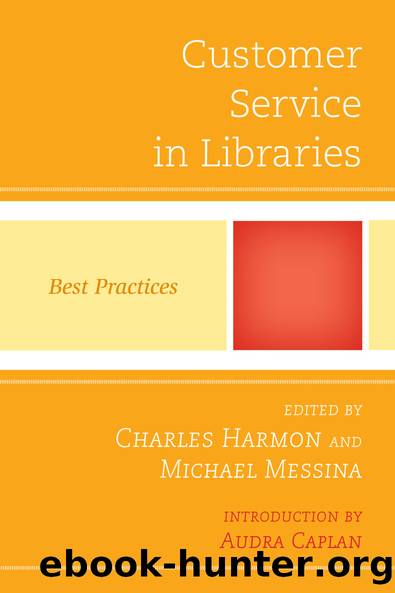
Author:Charles Harmon [Harmon, Charles]
Language: eng
Format: epub
Publisher: Scarecrow Press
Published: 2013-09-15T00:00:00+00:00
6
Improving Customer Service by Utilizing an Existing Technology Innovatively
Adriana Gonzalez
The Texas A&M University Libraries
The library landscape is changing at a rapid pace, with libraries as a place remaining an important component. With the changing library landscape, a greater demand is placed on study space conducive to individual learning and studying, as well as group study. For large academic libraries, space management and the balance between study space and materials is critical, especially as group learning and collaboration are incorporated into teaching curricula. Howe and Strauss (2000) point out that there is a ânew focus on teamwork; students prefer working together rather than alone.â The new emphasis of group learning and collaboration has direct implications for libraries, since they are now seen as more than just a place for books. Despite this trend, university infrastructures are unable to continue building or expand existing building space due to funding, time, and space constraints. It goes without saying that this is an ongoing challenge. So how does a large academic library manage such a high-demand resource such as study space in a fair and effective manner?
The Texas A&M University (TAMU) Libraries demonstrate how this can be accomplished through an effective space management model using an existing technology typically utilized in another customer service industry: the industry, restaurants; the technology, pagers. What this ultimately accomplished was improved customer service and satisfaction, which is the librariesâ main objective: to provide excellent customer service.
The Problem
In the middle of the 2000â2010 period, the TAMU was experiencing significant growth in enrollment, without the growth in infrastructure to match. In 2007, on a campus of approximately 40,000 students, 2,000 faculty, and 2,500 staff, the library was feeling the pressure for needed space. Students wanted and needed group study space, which was provided in dedicated group study rooms with varying capacities of 4 to 12 persons, as well as open group study space. There were 44 group study rooms and open study space for approximately 449 individuals, yet not all the open study space was conducive to group study. The 44 group study rooms were located in the Library Annex, which was open from Sunday at noon to Friday at 9:00 pm (24/5), from Saturday at 9:00 am to 9:00 pm, and continuously during finals week (24/7). The Library Annex is adjoined to the main campus library, the Sterling C. Evans Library, via skybridge. The Evans library, however, was not open extended hours, making the Library Annex the main library for students to study during the night hours.
The problem was the lack of a system to effectively manage the limited group study rooms with the high demand of students needing that space. There was much stress experienced by students waiting and by the staff at the service desk. To begin addressing this need, various models were tried before reaching the pager system as a solution. It is important to mention these previous models because so much in a solution is based on what has been learned and tried. Additionally, one
Download
This site does not store any files on its server. We only index and link to content provided by other sites. Please contact the content providers to delete copyright contents if any and email us, we'll remove relevant links or contents immediately.
| Anthropology | Archaeology |
| Philosophy | Politics & Government |
| Social Sciences | Sociology |
| Women's Studies |
Cecilia; Or, Memoirs of an Heiress — Volume 1 by Fanny Burney(32561)
The Great Music City by Andrea Baker(32021)
Cecilia; Or, Memoirs of an Heiress — Volume 2 by Fanny Burney(31958)
Cecilia; Or, Memoirs of an Heiress — Volume 3 by Fanny Burney(31944)
We're Going to Need More Wine by Gabrielle Union(19051)
All the Missing Girls by Megan Miranda(16043)
Pimp by Iceberg Slim(14519)
For the Love of Europe by Rick Steves(14156)
Bombshells: Glamour Girls of a Lifetime by Sullivan Steve(14079)
Talking to Strangers by Malcolm Gladwell(13375)
Norse Mythology by Gaiman Neil(13374)
Fifty Shades Freed by E L James(13245)
Mindhunter: Inside the FBI's Elite Serial Crime Unit by John E. Douglas & Mark Olshaker(9346)
Crazy Rich Asians by Kevin Kwan(9295)
The Lost Art of Listening by Michael P. Nichols(7507)
Enlightenment Now: The Case for Reason, Science, Humanism, and Progress by Steven Pinker(7315)
The Four Agreements by Don Miguel Ruiz(6767)
Bad Blood by John Carreyrou(6625)
Weapons of Math Destruction by Cathy O'Neil(6283)
